

Is Your Marketing Budget Actually Working? Here's How to Find Out

Let's have a real conversation for a second.
If I asked you right now what you spent on marketing your small business last month, you could probably tell me at least a ball park number. Your website hosting. Your email platform. That brand shoot you finally booked. Maybe you bought a social media course, hired a blog writer for 3 really strong pieces, or invested in a Pinterest strategist. Whatever it is, you know the number-ish. You paid the invoices and felt a little something about the money you spent.
Now if I asked you what that money did? Whether it actually brought in leads, moved the needle on visibility, or helped you book better clients?
...That's where you get quiet.
And listen—I get it. You're running a whole business. Tracking marketing performance sounds like something companies with dedicated departments do, not a wedding photographer or a calligrapher trying to keep all the plates spinning. But here's the thing I need to say as someone who does her own marketing and works with folks doing the same: spending money without knowing if it's working is very expensive.
Having a marketing budget is step one. Knowing whether it's actually doing its job? That's the part most small business owners put their heads in the sand over. And it's costing them more than they realize.
75.8% of Small Business Owners Spend Less Than $500/mo. on Marketing. So Your Time Is a Budget Line Too
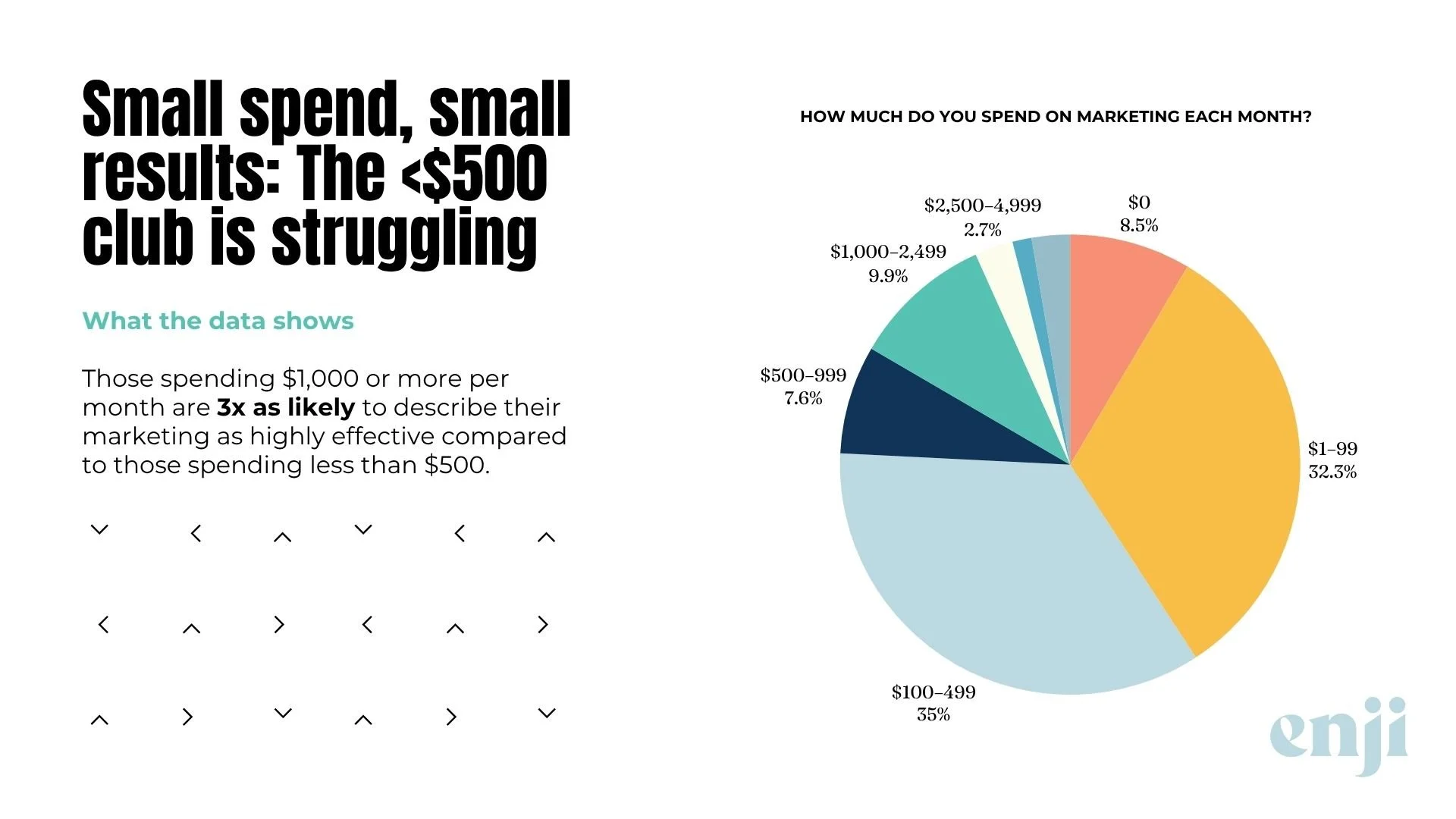
Before we really get into talking about dollars, I need to make something very clear: if you're doing your own marketing, your time is your marketing budget. And it's probably your biggest line item because I know most of you aren’t spending much money on your marketing.
According to Enji's 2025 State of Small Biz Report (we surveyed 245 small business owners across 40 states) 75.8% of them told us they spend less than $500 a month on their marketing. And when you pair that with the fact that 51% of small business owners don't outsource any marketing tasks that means more than half of you reading this are the strategist, the content creator, the copywriter, the scheduler, and the analyst all rolled into one.
So let's do a quick exercise. What's your hourly rate? If you charge $3,000 for a wedding package and it takes roughly 30 hours of your time from inquiry to delivery, that's $100/hour. If you're spending fewer than five hours a week on marketing (which 57.6% of small business owners do) that's $500 a week in your own time, or roughly $2,000 a month. That's a real budget line. It just doesn't show up on your bank statement the same way a Flodesk subscription does.
Now ask yourself: do you know if those hours are going toward what's actually working? Or are you spending most of them on the platform that feels most comfortable, the task that feels most fun, or the thing you've just always done?
You wouldn't let $2,000 a month walk out the door without knowing where it went. Your time deserves the same scrutiny.
What "Working" Actually Means Depends on What Marketing You're Spending On
Here's where I want to get extra practical with you, because "track your marketing" is advice that means nothing without specifics. What you measure should match what you're spending your marketing budget on. Because different investments have different indicators—and if you're watching the wrong numbers, you'll draw the wrong conclusions.
So let’s talk through a few examples of how you might be spending a mix of your time and money on marketing your small business.
If you've hired a blog writer the metric that matters most isn't how many words got written. It's organic website traffic and page views over time. Blog content is a long game (SEO takes three to six months to build momentum) so if you're two months in and panicking because you're not booked from it yet, that's not a fair evaluation. Set a six-month checkpoint and watch whether traffic to your site is trending up. That's the first signal.
If you're paying a social media manager look beyond follower count (which is largely a vanity metric) and focus on engagement rate, profile visits, and most importantly whether new inquiries mention finding you on social. That last one requires you to actually ask every single inquiry where they found you. Which you should be doing anyway. Add it to your contact form if you haven't and track your lead sources.
If you're running paid ads landing page views, cost per click, and lead form submissions are your north star. If people are clicking but not inquiring, the ad is working but your website or offer isn't converting. If no one's clicking, the targeting or creative needs work. Either way, the data tells you where to fix it.
If you're investing time in networking, relationships, or community building track where inquiries say they heard about you. Yes this is low-tech but it is high-value. It’s another reason to add a field to your inquiry form asking how leads found you that goes a long way towards understanding whether the two hours you spent at that venue open house were worth it.
If you're doing all of it yourself, the question isn't just whether your marketing is working—it's whether you're spending your limited hours on the things that are actually driving results or just the ones that feel most familiar. That takes data to answer honestly.
You Have to Track Your Numbers for Months Before You Start to See Patterns
Here's the thing about tracking your marketing numbers: one month of numbers tells you nothing. Two months is a little better. Three to six months? That's where the patterns start to show up—and patterns are what actually help you make smarter decisions about how you are going to spend your marketing budget.
I've talked to a lot of small business owners who have a gut sense of what's working. They feel like Instagram is bringing in leads. They think the blog might be doing something. They're pretty sure that networking event was worth it. But feeling and knowing are two very different things—and feelings are notoriously bad at catching the shifts that happen over time. Honestly, they’re just bad at telling the truth.
When you start tracking consistently, something changes. It's not that the data is magic. It's that you suddenly have something to compare against. You can see that inquiries spiked two months after you started blogging consistently. You can see that your website traffic dropped the month you stopped sending your newsletter. You can see that one channel you've been ignoring is quietly sending you more leads than the one you spend three hours a week on.
That's the difference between gut feelings and actually tracking your numbers. And you can't get there without a system that organizes the data in the same place, over time, connected to the work you're actually doing to influence those numbers.
Enji Makes Tracking Your KPIs Super Doable
Yes. I just dropped a new phrase on you. KPI means “key performance indicator.” And in Enji’s corner of the world, that’s how we refer to numbers.
Enji is the only marketing project management platform that brings the planning and the doing of your marketing together in one place. And that matters more than it sounds, because when your plan, your AI copywriter, your social media scheduler, and your KPIs all live in separate places, you do not have an easy way of getting your marketing done. Plus, you can't easily connect "I posted three times a week for two months" to "website traffic went up 30%" if your posting schedule is in one tool and your analytics are somewhere else entirely.
Enji's KPI dashboard is built specifically for small business owners who are doing their own marketing and trying to figure out if it’s working—not for data analysts with three monitors and a custom Tableau build. (What even is that?!) Enji helps you see what's working with your marketing and what isn't, so you can stop guessing if the time and money you’re spending is worth it and start making decisions based on what the numbers are actually telling you.
Enji is the tool that changed how Danison actually manages and understands his own marketing.
"Before Enji, I had no clue how to effectively market my biz, and honestly, it felt overwhelming. But this platform makes everything feel doable — it keeps me organized, helps me learn more about marketing, and gives me actual control over my social media, website, and blogging. The best part? I don't feel like I'm doing it alone."
That shift (from overwhelming to doable) is what I think doing your own marketing is supposed to feel like. And the data backs it up: according to Enji's 2025 State of Small Biz Report, small business owners who use data to guide their decisions are 2.8 times more likely to call their marketing “very” or “extremely” effective.
In the end, you probably don't need a bigger marketing budget. You need to know whether your current one is working.
Ready to find out?Start a free 14-day trial of Enji and see what your marketing looks like when the planning and the doing finally live in the same place.
Any Marketing Budget Can Work For You When Numbers Have a Seat at the Table
You wouldn't ignore your revenue for six months and hope it was trending in the right direction. You wouldn't skip your quarterly review because it felt complicated. Your KPIs deserve the same respect as every other line in your P&L because they're what's driving those revenue numbers in the first place.
Whether you're spending $300 a month on marketing or $3,000, the question is the same: is it working? And the only way to answer that honestly is to track your KPIs, give it enough time to show you patterns, and use a system that makes that process sustainable.
Your marketing budget is one of the most important investments in your business. Treat it like one.
Meet Tayler Cusick Hollman

Tayler Cusick Hollman is a marketing consultant turned small business champion and the founder of Enji, a project management platform designed to help you stop just thinking about doing your marketing and actually get it done. After more than a decade working alongside small business owners, Tayler recognized a common challenge: it wasn’t just knowing what to do—it was getting marketing done consistently. She built Enji to solve that problem. And by being one place you can plan and do your marketing, Enji helps small business owners turn ideas into finished tasks that make them money.